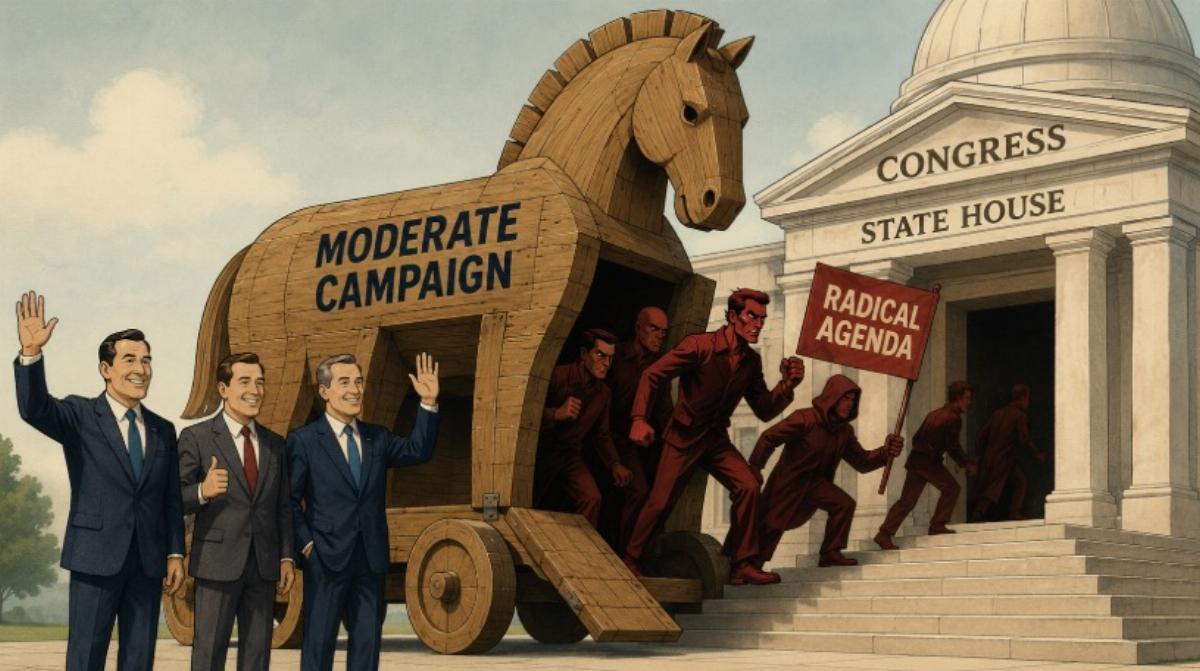


For more than three decades, Democrats have dreamed of turning Texas blue. Election after election, that dream has collided with political reality. Republicans have maintained their grip on statewide power, even as Texas has become younger, more diverse, and increasingly urban.
But the 2026 midterm elections are raising an uncomfortable question for Republicans: What happens when their greatest political advantage -- the Republican identity of Texas -- is no longer enough to guarantee victory?
The Senate contest between Democratic state Representative James Talarico and Republican Attorney General Ken Paxton may provide an answer.
A Republican Stronghold Under Pressure
Texas has not elected a Democrat to statewide office since 1994. Donald Trump carried the state by nearly 14 percentage points in the 2024 presidential election. Those numbers hardly suggest an imminent Democratic revolution.
Yet recent polling tells a more complicated story.
An October CBS News/YouGov survey places Talarico at 51 percent and Paxton at 49 percent among likely voters. A University of Houston survey also shows Talarico narrowly ahead, 48 percent to 46 percent.
Neither result guarantees a Democratic victory. The margins are close enough that turnout, late campaign developments, and polling uncertainty could determine the outcome.
Nevertheless, the fact that Democrats are seriously competing for a Senate seat in Texas represents a significant political development.
The question is whether voters are embracing the Democratic Party or simply expressing dissatisfaction with the Republican candidate.
The Paxton Problem
Ken Paxton is not an ordinary Republican nominee.
His political career has been marked by legal controversies, impeachment proceedings, and disputes within his own party. Although the Texas Senate acquitted him in his 2023 impeachment trial, the political consequences have not necessarily disappeared.
For some traditional Republican voters, supporting Paxton has become a question of political loyalty versus personal judgment.
That distinction matters.
A Republican voter who refuses to support Paxton does not automatically become a Democrat. Such a voter might leave the Senate contest blank or reluctantly vote for Talarico.
This creates an unusual opportunity for Democrats: winning without necessarily converting Texas into a Democratic state.
It also presents a warning for Republicans. Party loyalty may remain powerful, but it is not unlimited.
The Suburban Battleground
The political future of Texas may be decided less by its largest cities than by the communities surrounding them.
Dallas–Fort Worth, Houston, Austin, and their expanding suburbs have experienced demographic and economic changes that complicate traditional electoral assumptions.
College-educated voters, younger families, and politically independent professionals do not always fit neatly into the state's historical Republican coalition.
But Democrats face a challenge of their own.
Suburban dissatisfaction with one Republican politician should not be confused with a permanent ideological realignment.
Voters who reject Paxton in November may still support Republican Governor Greg Abbott or other conservative candidates on the same ballot.
That contrast may be the most revealing political development of all.
Texas voters may be increasingly willing to distinguish between individual candidates rather than simply vote according to party labels.
The Latino Vote: A Warning for Both Parties
Another important development concerns Hispanic voters.
Trump's gains among Latino voters in 2024 challenged the assumption that demographic change would inevitably benefit Democrats.
But political loyalty is rarely permanent.
Recent polling suggests that Talarico has opportunities to attract Hispanic voters who might not otherwise support Democratic candidates.
Economic concerns, dissatisfaction with political leadership, and disagreements over immigration enforcement may influence their choices.
For Republicans, the lesson is that gains made in one election cannot be taken for granted.
For Democrats, the warning is equally important: Latino voters are not a single ideological bloc whose support can be assumed.
Both parties must compete for their votes.
A Different Kind of Democrat?
Talarico's political appeal also deserves attention.
Rather than treating religion and progressive politics as incompatible, he has incorporated Christian language and moral arguments into his public political identity.
This approach challenges a longstanding Republican advantage in communicating with religious voters.
But it also raises a question about the Democratic Party's future.
Can Democrats become more competitive in conservative states by emphasizing shared values, economic concerns, and personal credibility rather than ideological confrontation?
Talarico's campaign suggests one possible answer.
Whether that strategy can succeed statewide remains uncertain.
Texas Is Not Blue, At Least Not Yet
The temptation to declare a historic political transformation is understandable.
A Democratic victory in Texas would reverberate across Washington, disrupt Republican electoral calculations, and potentially reshape the national political landscape ahead of 2028.
But one competitive Senate race cannot establish that an entire state has changed its political identity.
Texas remains structurally favorable to Republicans. Its rural communities, conservative electorate, and established Republican political organization continue to provide formidable advantages.
What has changed is the perception of inevitability.
For years, Republicans could approach statewide elections assuming that the state's political identity would carry them across the finish line.
In 2026, that assumption is being tested.
The real story may not be that Texas is turning blue.
It may be that Texas is becoming a state where Republicans can no longer afford to take victory for granted.
And in American politics, that distinction could prove far more consequential than a change of color on an electoral map.